Case study | Standardizing qPCR-based LDT preparation at APHM: 12 years of partnership in clinical diagnostics

What if your LDTs were ready-to-use?
Discover how outsourcing the preparation of 35 in-house LDTs helps Elsa Prudent to reduce hands-on time, ensures cost-effectiveness, improves traceability and reduces risks thereby supporting alignment with evolving IVDR expectations.
A routine qPCR diagnostic environment with specific constraints
High-volume diagnostic laboratories face constant pressure to deliver reliable results at scale while managing costs, evolving technologies, and increasing regulatory expectations. At Assistance Publique – Hôpitaux universitaires de Marseille (APHM), one of France’s largest hospital groups, these challenges have driven the adoption of a standardized, ready-to-use qPCR diagnostic assay preparation approach to support their large and demanding diagnostic portfolio.
This portfolio covers more than 400 pathogenic targets, including over 150 viral assays, more than 150 bacterial targets, and a broad range of parasitic infections. At this scale, relying exclusively on commercial CE-IVD kits is neither economically viable nor always practical, particularly when certain assays are not readily available on the market. Thanks to its strong internal expertise in molecular assay design and infectious disease diagnostics, APHM has developed its own In-House qPCR In Vitro Diagnostic assays (IH-IVD assays). Also called Laboratory-Developed Tests (LDTs), they play a key role in routine clinical testing.
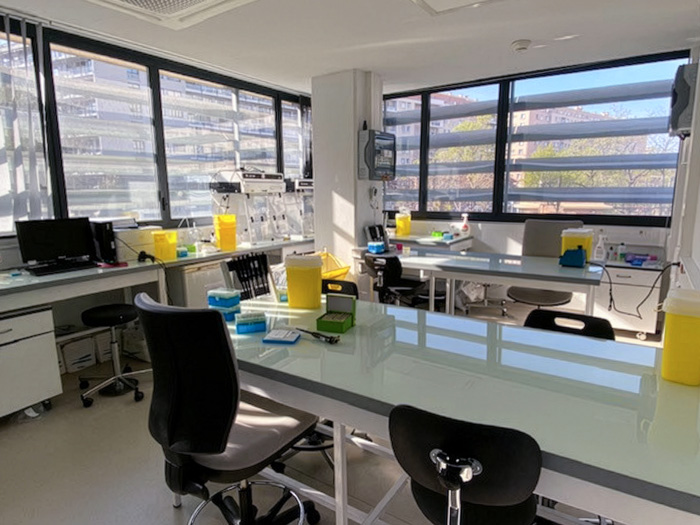
APHM leverages its strong in-house expertise in qPCR assay design while outsourcing high-volume assay preparation to ensure efficiency, traceability, and manufacturing consistency. Photo courtesy of APHM.
However, preparing and managing such a broad LDT portfolio fully in-house quickly becomes demanding, requiring significant hands-on time, robust traceability, and documentation aligned with ISO 15189–compliant validation and In Vitro Diagnostic Regulation (IVDR) Art. 5(5) expectations.
Why standardized assay preparation is essential for large LDT portfolios
For laboratories operating at high throughput, the challenge is not the assay design itself, but rather ensuring that LDT preparation remains:
- efficient despite limited staff resources
- traceable across multiple assays and reagent lots
- aligned with ISO 15189 validation requirements for diagnostic use and IVDR expectations for LDTs
- compatible with evolving qPCR platforms and consumables
To address these constraints while maintaining control over assay content, APHM chose to rely on a standardized assay preparation approach in partnership with Eurogentec.
How Eurogentec supports APHM’s diagnostic workflows
For more than 12 years, Eurogentec has supported APHM with a custom assay preparation service tailored to high-volume diagnostic needs. Today, this collaboration includes a ready-to-use solution where primers, probes, and Master Mix are premixed and dispensed into assay-specific strips. This approach is currently implemented across 35 different assays, each clearly identified to ensure safe routine use.
The service includes:
- cleanroom formulation of ready-to-use premixes (primers, probes, and Master Mix combined)
- robotic dispensing into 8-tube qPCR strips
- assay identification through distinct trigrams for each target
- lot-specific documentation to support method validation and traceability
- partial deliveries to accommodate limited on-site storage capacity at -20°C
This standardized approach helps reduce hands-on time, enhance traceability and reproducibility while maintaining flexibility and compliance.
Measurable benefits in routine high-volume qPCR diagnostics
According to Dr. Elsa Prudent, Chief Hospital Engineer in Molecular Biology at APHM, outsourcing assay preparation delivers tangible benefits in daily diagnostic operations, particularly in a high-throughput environment with limited staffing resources.
Reducing hands-on time is one of the first advantages observed. With many assays to manage, extended preparation timelines quickly become unsustainable. As Dr. Prudent explained: “Even with CE-IVD kits, there is still a manual preparation step involved. With the pre-filled strips, the assay is truly ready-to-use, which is essential for us, given our limited staffing resources.”
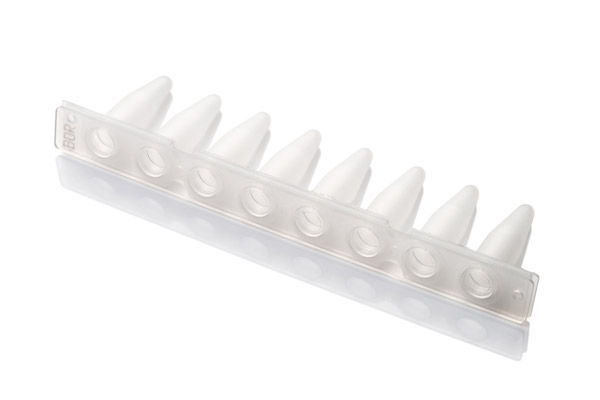
Ready-to-use qPCR strips prepared for APHM. Premixed primers, probes, and Master Mix are dispensed into 8-well strips, minimizing hands-on time while enhancing traceability.
She also highlights cost efficiency as a decisive factor for a laboratory operating under tight budget conditions: “Price is an important consideration for us, given our tight budget. With your service, price per point is typically five to ten times lower than that of commercial kits.”
Beyond cost and efficiency, Dr. Prudent emphasizes the importance of traceability and cleanroom production when outsourcing LDT preparation. Achieving this level of standardization internally would be difficult at scale, she noted: “We don’t have an equivalent service internally, and even if we did, working with you provides a higher level of traceability. Your cleanroom production and traceability fully meet the standards we expect from an outsourced partner.”
She further points out the need for operational flexibility, particularly in hospital environments: “Having flexibility with plastics and compatibility across different platforms is important, especially since equipment can change with public tenders.”
Finally, Dr. Prudent underlines the logistical benefits of partial deliveries: “Staggered deliveries, usually in two batches, are essential for us because our storage space is limited.”
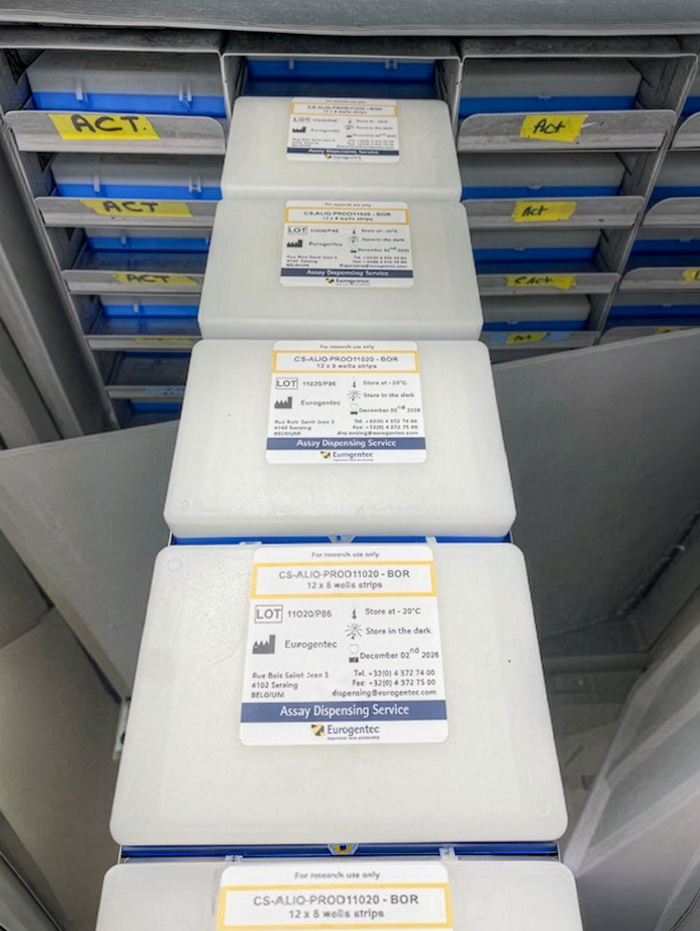
Lot-labeled qPCR strip boxes stored at –20 °C, reflecting the volumes handled in routine testing and the importance of traceable packaging combined with flexible, partial delivery options. Photo courtesy of APHM.
A long-term, standardized approach to qPCR LDT production
Through more than 12 years of partnership, APHM relies on 35 ready-to-use qPCR premixes to streamline LDT production across a large and complex diagnostic portfolio. This approach saves valuable hands-on time while offering flexibility in assay content, formats, and delivery planning: an essential balance in a high-volume diagnostic hospital environment. At the same time, ready-to use format, standardized clean-room manufacturing and structured documentation help to ensure alignment with IVDR requirements for LDTs in routine clinical diagnostics (Art. 5(5)).
As diagnostic and regulatory landscapes continue to evolve, APHM plans to keep outsourcing its in-house assay preparation, confident in a solution that supports long-term alignment with IVDR requirements for LDTs.
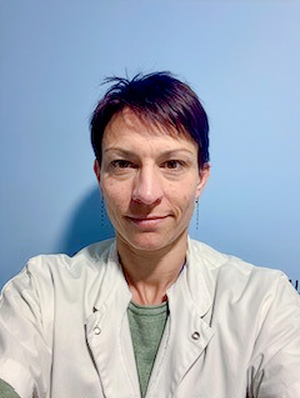
Dr. Elsa Prudent, Chief Hospital Engineer in Molecular Biology at APHM: “Communication with your team has always been easy and pleasant. We’re very happy to work with you, and we hope this collaboration will continue.” Photo courtesy of APHM.
Supporting high-volume LDT production with confidence
This case study illustrates how Eurogentec supports diagnostic laboratories in standardizing and sustaining LDT workflows, strengthening traceability, and maintaining regulatory readiness. Without compromising assay flexibility or scientific control.
Download the case study (url case study)
Want to get your assay in a ready-to-use format?
Discover the full value of outsourcing your assay preparation