ATTO™ dyes for double dye probes: consistent performance in qPCR and dPCR assays

This article reviews the key characteristics of high-quality fluorophores and examines how ATTO™ dyes perform in multiplex PCR applications compared with commonly used fluorescent dyes.
In probe-based qPCR and digital PCR (dPCR), fluorophores are critical components that directly influence signal detection, assay sensitivity, and multiplexing performance. The choice of fluorescent dye affects not only analytical performance but also assay design flexibility and commercialization opportunities.
Among the fluorophores available for molecular diagnostics and research applications, ATTO™ dyes have gained attention for their combination of strong fluorescence properties and broad spectral coverage. In addition, Eurogentec provides these dyes within an IP-free framework, offering greater flexibility upon assay commercialization.
1. What defines a high-quality fluorophore for qPCR and dPCR?
Selecting fluorescent reporter dyes involve more than matching excitation and emission to an instrument channel. Several characteristics influence assay performance and long-term reliability:
- High brightness
- Strong photostability
- Thermal stability
- Distinct spectral properties
- Thermal stability
- Instrument compatibility
Bright fluorophores generate stronger fluorescence signals, facilitating target detection and improving assay sensitivity, particularly when target concentrations are low.
Repeated excitation during PCR cycling can lead to photobleaching. Photostable dyes maintain their fluorescence over time, preserving signal quality throughout the experiment.
PCR assays expose fluorophores to repeated heating and cooling cycles. Thermally stable dyes maintain their optical properties during amplification.
For multiplex assays, fluorophores should have clearly separated excitation and emission spectra to minimize channel overlap.
PCR assays expose fluorophores to repeated heating and cooling cycles. Thermally stable dyes maintain their optical properties during amplification.
A suitable fluorophore should be compatible with standard optical filters and detection systems commonly used in qPCR and dPCR platforms. These characteristics collectively determine how effectively a fluorophore supports reliable target detection and multiplex assay design.
2. Why choose ATTO™ fluorophores?
Broad spectral coverage and robust fluorescence properties
ATTO™ dyes combine several characteristics that are particularly valuable for Probe-based PCR applications. They are known for:
- High fluorescence quantum yields
- Strong absorption coefficients
- Excellent photostability
- High thermal stability
- Consistent signal generation across amplification runs
- Coverage of the visible and near-infrared spectrum
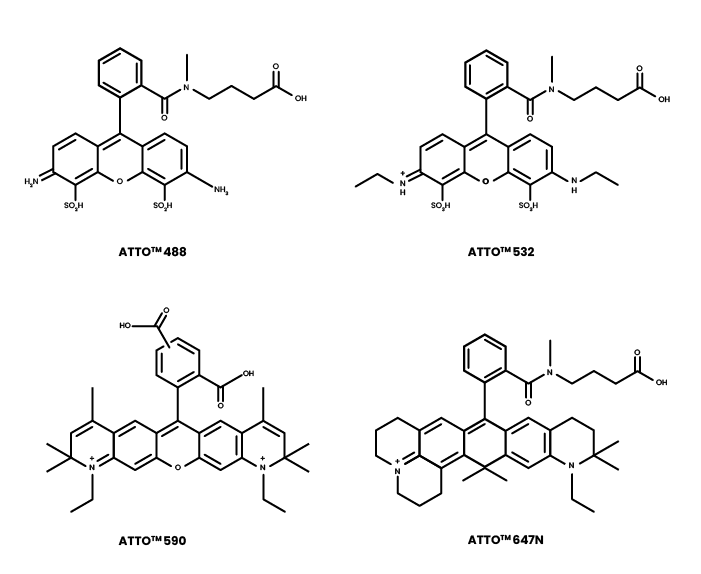
The robust fluorescence properties of ATTO™ dyes are linked to their rigid chromophore structure, which contributes to both photostability and thermal stability. This structural rigidity helps limit non-radiative energy loss and reduces degradation under demanding experimental conditions.
Structure example of the ATTO dyes tested in this article:
As an example, Figure 1 shows the photostability of ATTO™ 647N compared to Cy5® under continuous irradiation. ATTO™ 647N retains its absorbance for a longer period, demonstrating greater resistance to photobleaching. While this example focuses on a single fluorophore, it illustrates a characteristic shared across the ATTO™ dye family: stable fluorescence performance over time.
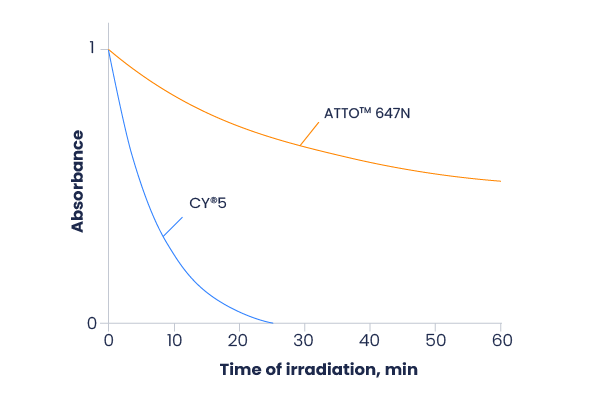
Fig 1. Photostability comparison of ATTO™ 647N and Cy5® under continuous irradiation. Source: ATTO-TEC GmbH. ATTO™ 647N Product Information Sheet.
For a broader overview, read the article “Why choose ATTO™ Dyes for quantitative and digital PCR Probes?”Multiplexing capability
One of the main advantages of ATTO™ dyes is their suitability for multiplex qPCR and dPCR assays.
The broad portfolio of available ATTO™ dyes also allows assay developers to select fluorophores that match their instrument configuration while supporting increasingly complex multiplex designs.
Their well-defined excitation and emission spectra facilitate signal separation between channels, reducing spectral overlap and simplifying multiplex assay design
Figure 2 illustrates a four-target amplification assay using four different ATTO™ dyes.
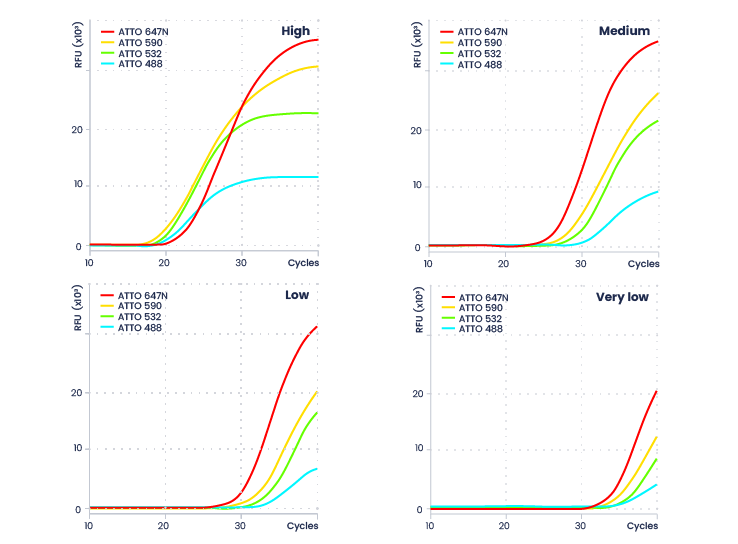
Figure 2. 4-plex amplification (using Takyon® Ultra Master Mix) of Sarbeco (ATTO™ 488; channel 1), N1 (ATTO™ 532; channel 2), N2 (ATTO™ 590; channel 4), and SPC (ATTO™ 647N; channel 5).
Across conditions, several observations can be made:
- Amplification curves remain clearly defined for all dyes.
- Fluorescence signals enable reliable detection in each channel.
These results demonstrate that ATTO™ dyes can be effectively combined in multiplex assays while maintaining clear signal discrimination between channels.
An IP-free alternative for commercial assay development
For assays intended for commercialization, technical performance is not the only consideration when selecting fluorophores. Intellectual property restrictions can affect the transition from development to market. Choosing IP-free dyes early in assay development can help avoid a later dilemma between paying licensing royalties and redesigning and revalidating the assay, potentially saving significant time and resources.
Many commonly used fluorescent dyes may be associated with licensing requirements depending on the intended application. By contrast, Eurogentec's ATTO™ dye portfolio is available within an IP-free framework.
This provides several advantages:
- No royalty fees
- No licensing requirements for commercial use
- Straightforward assay commercialization
- Reduced legal and administrative complexity
In addition, ATTO™ dyes cover the full visible spectrum and are compatible with standard qPCR and dPCR instruments, enabling straightforward integration into existing workflows.
To facilitate assay development, Eurogentec's Access™ dyes and quenchers portfolio includes ATTO™ dyes designed as alternatives to commonly used proprietary fluorophores.
Click here to discover our full Access™ selection.
Equivalent performance compared to commonly used fluorophores
To evaluate the performance of ATTO™ dyes, amplification assays were performed using equivalent probe designs and compared to commonly used fluorophores under the same experimental conditions. For each comparison, amplification plots illustrate fluorescence signal generation during PCR cycling, while the accompanying tables summarize mean Cq values across a DNA dilution series, assay linearity (R²), and PCR efficiency. Together, these parameters provide an objective assessment of target detection, amplification performance, and assay reproducibility.
Each assay has been performed using Takyon® Ultra from Eurogentec.
Channel 1: ATTO™ 488 versus FAM
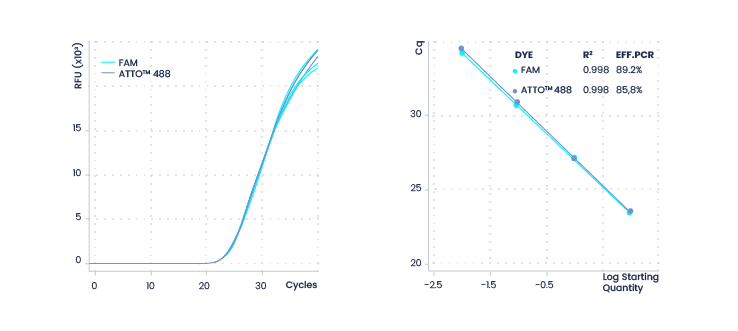
Figure 3. Amplification plot comparing ATTO™ 488 to FAM™ using 10 ng DNA input (left) and standard curves comparing ATTO™ 488 and FAM™ across DNA input concentrations, with corresponding R² and PCR efficiencies (right).
ATTO™ 488 and FAM™ showed comparable qPCR performance across all tested DNA concentrations. Mean Cq values differed by no more than 0.3 cycles (23.4 vs. 23.3 at 10 ng DNA input), remaining within the range of normal experimental variability. Both assays also showed excellent linearity (R² = 0.998) and highly reproducible amplification curves across replicates. Although the calculated PCR efficiency was slightly lower for ATTO™ 488 (85.8% vs. 89.2% for FAM™), this difference did not affect target detection or quantification over the tested range. Under these experimental conditions, ATTO™ 488 can therefore be considered a suitable alternative to FAM™ for qPCR applications.
Channel 2: ATTO™ 532 versus YY® and HEX™
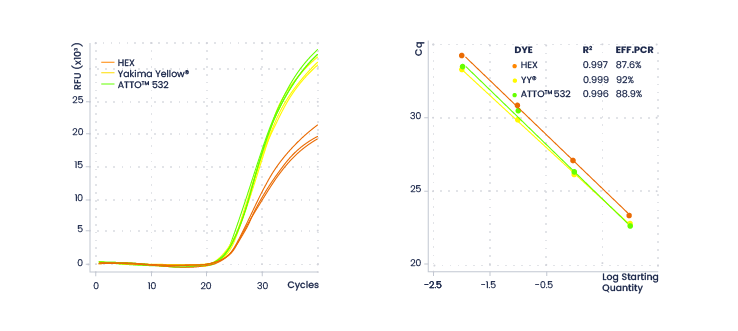
Figure 4. Amplification plot comparing ATTO™ 532 to Yakima Yellow® and HEX™ using 10 ng DNA input (left) and corresponding standard curves showing PCR efficiency and linearity (right).
ATTO™ 532 and YY® showed highly comparable amplification performance across all tested DNA concentrations. Mean Cq values differed by no more than 0.5 cycles, indicating equivalent target detection. The amplification curves also overlapped closely and reached slightly higher fluorescence levels.
Compared with HEX™, ATTO™ 532 generated a stronger fluorescence signal and consistently lower Cq values. For example, at 10 ng DNA input, mean Cq values were 22.7 for ATTO™ 532, 22.8 for YY®, and 23.4 for HEX™.
These results demonstrate that ATTO™ 532 performs equivalently to YY® while providing improved signal intensity compared with HEX™ making it a suitable option for channel 2 applications.
Channel 4: ATTO™ 590 versus Texas Red®
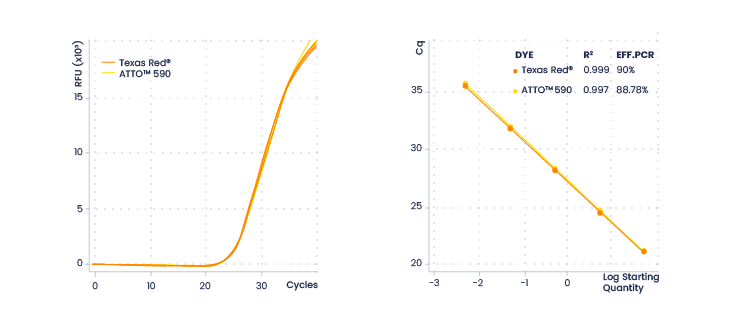
Figure 5. Amplification plot comparing ATTO™ 590 to Texas Red® using 5 ng DNA input (left) and corresponding standard curves showing PCR efficiency and linearity (right).
ATTO™ 590 and Texas Red® produced nearly identical amplification profiles across the tested DNA concentration range. Mean Cq values differed by no more than 0.2 cycles, indicating equivalent target detection. For example, at 5 ng DNA input, mean Cq values were 24.7 for ATTO™ 590 and 24.5 for Texas Red®.
The amplification curves overlapped closely throughout the PCR run and generated comparable fluorescence levels. Both dyes also showed excellent assay linearity (R² = 0.997–0.999) and similar PCR efficiencies (88.7% and 90.0%, respectively).
These results demonstrate that ATTO™ 590 performs equivalently to Texas Red®, supporting its use as a direct alternative for channel 4 applications.
Channel 5: ATTO™ 647N versus Cy5®
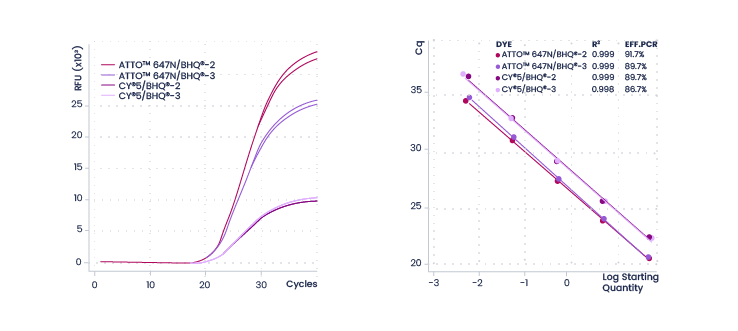
Figure 6. Amplification plot comparing ATTO™ 647N and Cy5® using 5 ng DNA input with BHQ®-2 and BHQ®-3 quencher combinations (left) and corresponding standard curves showing PCR efficiency and linearity (right).
- ATTO™ 647N as an alternative to Cy5®
- Effect of quencher selection
- ATTO™ 647N: Beyond qPCR performance
Using BHQ®2 as the quencher, ATTO™ 647N consistently outperformed Cy5® under the tested conditions. Across all DNA concentrations, ATTO™ 647N generated lower Cq values, indicating earlier target detection. For example, at 5 ng DNA input, mean Cq values were 23.8–24.0 for ATTO™ 647N compared with 25.5–25.6 for Cy5®. ATTO™ 647N also produced higher fluorescence signals, resulting in steeper amplification curves. Both assays showed excellent linearity (R² = 0.999), while PCR efficiencies were comparable to or higher than those obtained with Cy5®. Under the tested conditions, these results indicate that ATTO™ 647N provides stronger signal intensity and earlier target detection than Cy5®, making it a suitable choice for channel 5 qPCR applications.
To evaluate the impact of quencher selection, ATTO™ 647N-labeled probes were tested with both BHQ®2 and BHQ®3. Under the tested conditions, both probe designs demonstrated excellent amplification performance, with comparable Cq values and assay linearity. However, probes quenched with BHQ®2 consistently generated higher fluorescence signals than those quenched with BHQ®3, resulting in steeper amplification curves and improved signal intensity. These findings indicate that pairing ATTO™ 647N with BHQ®2 provides the strongest overall fluorescence performance while maintaining reliable qPCR amplification.
Beyond the qPCR results presented here, ATTO™ 647N is recognized for its high fluorescence brightness and photostability. These properties contribute to robust and stable fluorescence signals and have made ATTO™ 647N a widely used fluorophore for demanding fluorescence-based applications. Combined with the qPCR performance demonstrated in this study, these characteristics make ATTO™ 647N paired with BHQ®2 a compelling option for channel 5 qPCR assays intended for research or commercialization.
Channel 6: ATTO™ 680 versus Cy5.5®
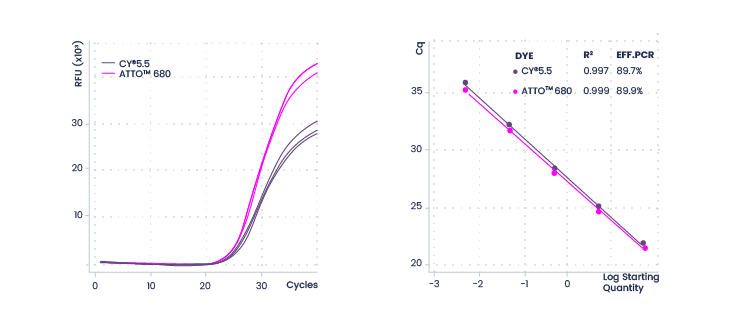
Figure 7. Amplification plot comparing ATTO™ 680 and Cy5.5® using 5 ng DNA input (left) and corresponding standard curves showing PCR efficiency and linearity (right).
ATTO™ 680 and Cy5.5® both showed robust amplification performance across the tested DNA concentrations. However, ATTO™ 680 consistently generated lower Cq values, with differences of approximately 0.8–1.0 cycles compared with Cy5.5®, indicating earlier target detection. At 5 ng DNA input, mean Cq values were 24.4 for ATTO™ 680 and 25.2 for Cy5.5®. In addition, ATTO™ 680 produced a markedly stronger fluorescence signal while maintaining excellent assay linearity (R² = 0.999) and good PCR efficiency (89.9%). [BD19.1]These results indicate that ATTO™ 680 provides enhanced signal intensity and earlier detection compared with Cy®5.5 while maintaining equivalent amplification performance.
Conclusion
ATTO™ dyes combine the characteristics expected from high-performance fluorophores with practical advantages for assay development and commercialization.
Their strong fluorescence properties, thermal and photochemical stability, and broad spectral coverage support reliable signal generation in both qPCR and dPCR applications. Their well-defined spectral profiles also facilitate multiplex assay design by enabling clear signal separation across detection channels.
The experimental comparisons presented here demonstrate that ATTO™ dyes perform at least equivalently to widely used fluorophores such as FAM™, HEX®, and Texas Red®. In some cases, they may provide additional benefits, as illustrated by the stronger fluorescence signal generated by ATTO™ 647N compared with Cy5®.
Combined with their IP-free status at Eurogentec and compatibility with common PCR platforms, ATTO™ dyes represent a practical alternative for developers seeking to maintain assay performance while simplifying commercialization and expanding multiplexing possibilities.
With coverage across the visible and near-infrared spectrum, our ATTO™ dye portfolio offers solutions for a wide range of PCR applications.